
What is arthritis?

Arthritis is something we’ve all heard of.
Its a word that gets thrown around a lot, usually in the phrase “just a bit of arthritis”.
Do you actually know what it is?
And would you know if your cat had arthritis?
What is OA?
Arthritis literally means inflammation of a joint.
It can affect any joint, causing pain, stiffness and poor mobility.
Anything that makes a joint unstable can cause arthritis.
It may start following an injury such as a fracture or ligament injury, or it may be due to badly formed joints where the bones don’t come together quite as they should.
Over time, instability in the joint causes changes in the bones, cartilage (the soft tissue that protects the bones), and the joint fluid.
Arthritis can affect cats of any age, but is more common in middle-aged and older cats.
Could your cat have arthritis?
Cats are masters of deception and will easily adapt their lifestyle to allow for illness or injury.
This makes life easier for them, but it can make it difficult for us to spot when there’s a problem.
Here’s some things to look out for that may suggest your cat is struggling with his joints…
Studies have shown that 60-90% of cats over 12 years old have arthritis.
Older cats are more likely to be affected.
He’s less active
Cats are pretty sensible (most of the time!) so when their joints start to feel a bit stiff cats will usually stop doing the things that make them sore or that they find difficult.
They’ll avoid those big jumps up onto a wall or fence, they may stop climbing trees or sitting in their favourite spot on the window ledge.
If you’ve noticed that your cat is avoiding climbing or jumping up, or if he’s stepping down gradually rather than in one leap, then he may be feeling a bit sore.
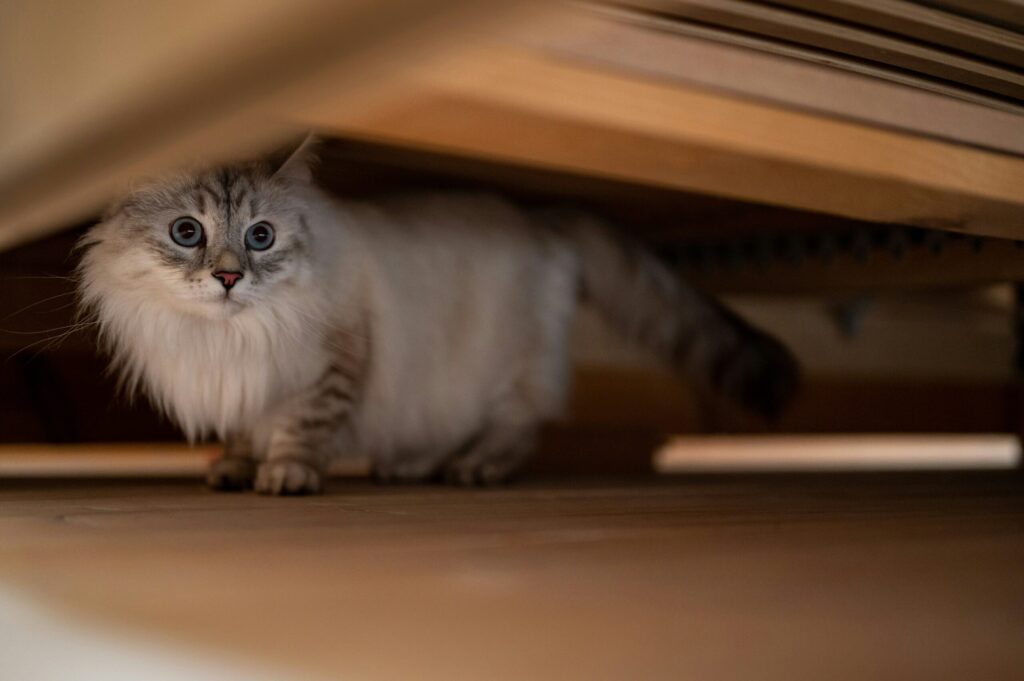
She’s grumpy or hiding
When cats aren’t feeling their best they will often take themselves away somewhere to a favourite hideaway.
They will avoid interacting with the family.
Some painful cats may bite or scratch when they are stroked or groomed.
If your previously sociable and friendly cat has started hiding away, or if she resents being stroked, then
she may be telling you that she’s painful.
Dull or Matted Coat

It can take some effort for a cat to reach all of the spots of his coat that need grooming.
If his joints are stiff then it may hurt to reach all the way down to his tummy or back to his hips.
Cats with arthritis may groom themselves less and they may be prone to knots and matts, especially
around their back end.
Limping
This one may seem obvious but a lot of owners don’t always appreciate when their cat is limping or what it means.
If your cat is favouring one leg or not putting it down, bobbing her head with each step, or moving stiffly without bending her joints, then she is in pain.
Cat’s don’t limp for fun, or to get attention.
Cats limp because something hurts, and a persistent limp may be a sign of injury, disease, or arthritis.
What Will My Vet Do?

If you think your cat may be showing signs of arthritis then get him checked out by a vet.
Your vet will chat to you about your concerns and any signs you may have noticed at home.
She will examine your cat and assess his joints, level of pain, and mobility.
Cats don’t always behave in the vets as they do at home, so it can be useful to take some videos on your phone so the vet can see how your cat moves at home.
Xrays or a CT of your cat’s joints can be taken to look for signs of arthritis and to see how severely affected the joints may be.
Xrays and CT’s are useful even in the early stages of arthritis to look for signs of joint abnormalities that may be correctable and to rule out other causes of joint pain and stiffness.
Blood tests and testing the joint fluid can help with this as well.
The earlier arthritis is identified the faster your cat can get treatment.
Treating Arthritis in Cats
The good news is that, once diagnosed, we have lots of options for managing arthritis in cats.
Although we can’t get rid of the arthritis, we can usually help your cat feel more comfortable and allow him to get back to climbing trees and hopping over fences.
Weight Loss

If your arthritic cat is carrying some extra weight then this will put extra pressure on his sore joints.
Losing even a little bit of weight will ease the pressure and his joints and help him to feel more comfortable.
Supplements and Nutraceuticals

A good joint support supplement can help to improve cartilage, maintain tendons and ligaments, and make the joint fluid more slippery.
All of that will help your cat’s achy joints to move better.
Not all supplements are created equal though, so discuss the options with your vet to decide which one is
best for your cat.
Physiotherapy and Acupuncture
Although it’s not suitable for every cat, many cats will tolerate and even enjoy physio exercises and acupuncture.
Done regularly these treatments can hep improve mobility, reduce pain, and slow the progression on arthritis.
Anti-inflammatory Medication
For some cats weight loss and supplements aren’t enough to keep them comfortable.
For these guys anti-inflammatory medication may be necessary.
A lot of owners worry about starting their cat on pain medication but modern treatments are generally safe, effective, and designed for long term use.
Your vet can advise which medications are most suitable for your cat.
Monoclonal Antibodies
This is one of the newest and most exciting options for managing arthritis pain in cats.
It is given as an injection once a month and provides specific and targeted arthritis management with very few side effects.
It can be used alongside most other medications and is generally safe even in older cats or cats with other health conditions.
Key Points

- Arthritis is really common in middle aged and older cats.
- Cats are masters of disguise, making signs of arthritis hard to spot sometimes.
- If your cat is less active, avoiding jumping, or is limping, then speak to your vet.
- There are lots of treatment options for managing arthritis in cats.
- The sooner arthritis is identified in cats the better it can be treated.
